|
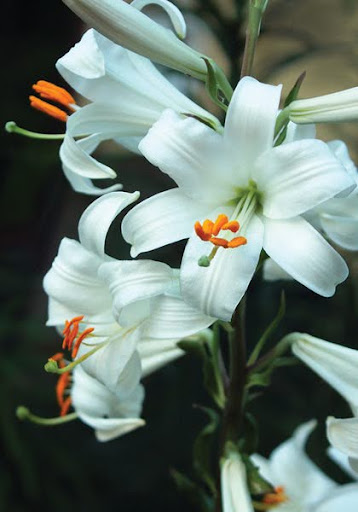
A customer recently noted that she wanted to order Madonna Lily bulbs for making a salve for sprains. This sparked our interest, so we asked for more information on herbal remedies and Erica G. From By The Roots sent us this article…
There was a time, long ago, when humans instinctively understood that every plant they encountered was either food, medicine, or poison—knowledge gained through observation, experience, and no small amount of trial and error. While much of that awareness has faded, the connection between people and plants has never truly been lost—only forgotten.
My education with the plants began with what is considered the “western” herbal tradition. Western meaning European and the Americas versus Asia, India and African herbal traditions. Once I’d learned about many of those herbs, I turned my attention to the plants I grew up around here in the Sonoran desert where I still live - and there are abundant, amazing medicinal herbs here! However, I’ve always found myself drawn to the European herbs of old.
When I was researching herbs to use in my salves, I not only reached for the herbs that grew around me, but also the older European herbals, searching for plants that might lend their unique properties to my salves. In particular, I was looking for herbs that might help heal tendons, ligaments and muscles. I had recently suffered a terrible ankle sprain and while my known allies were offering me relief from swelling and pain, I was wondering if there were herbs that might help repair the damage beneath the swelling - that part of the sprain that remains and lets you know when the weather’s about to change. I wanted total healing and I knew the body is capable of it, I just wondered if there were herbs that could give it a little help.
My introduction to the Lily bulb as medicine came through reading Matthew Wood’s book Seven Herbs: Plants as Teachers. He mentioned 2 Lily species, Lilium longiflorum and Lilium candidum and noted they could be used interchangeably. And while he noted they were mostly used for female troubles of all kinds, one part of that particular chapter caught my attention. Wood mentions a quote from Nicolas Culpeper (in his Herbal of 1657) where he stated that an ointment made of the root would “unite the sinews when they are cut”. (Wood, 1986) I was intrigued.
I had already explored herbs like Ruta graveolens (rue) to heal ligaments and damaged tendons, but I wasn’t finding a whole lot in the modern herbals as far as tissue healing except for Polygonatum (Solomon’s seal). I typically want my salves to contain many herbs that do similar things so that they can be useful to a broader spectrum of ailments as well as individuals (we all have our own unique makeup and some plants will pair better with us than others). Thus I began my experiment with the Lily bulbs.
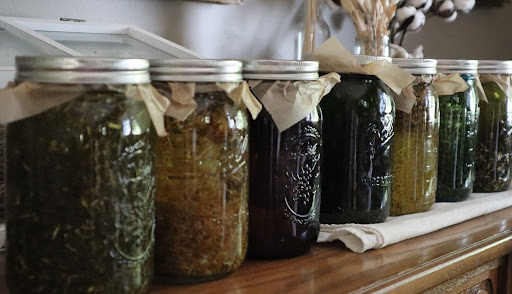
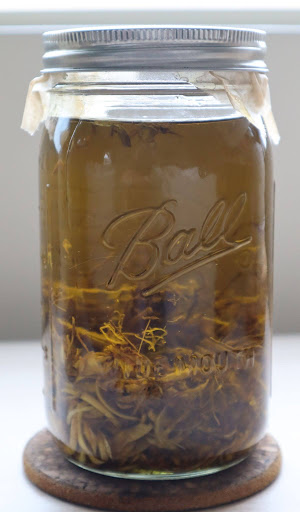
I had no modern recipe to refer to, but I did find a mention of both the fresh and dried bulbs being used in Volume 2 of A Modern Herbal by Mrs. M Grieve. I tried putting half the freshly chopped bulbs in olive oil. I dried the other half before I added them to oil (in a separate jar) to macerate for several weeks.
Once strained, I found the oils to smell identical. Since scent is an excellent organoleptic indicator in herbal medicines, I decided they would probably act similarly. Of course, I am not a scientist, so my experience with the Lily oil has been anecdotal at best, but other people have used it and confirmed my findings. I made 2 batches of my sprain salve, one with the fresh bulb oil and one with the dried. Then I tried them both on myself - one on my old ankle sprain (to see if it would facilitate a complete healing) and the other on my tendonitis in my right elbow (from playing pickleball a little too furiously!). Both took the pain away almost immediately. Over the course of using both for several weeks, I noticed a great reduction in pain and swelling, and an improvement in my range of movement.
I’m happy to report that my ankle healed completely - no more sore ankle when the weather changes! And my elbow healed as well, although it took a bit longer, because I was still playing pickleball (you can’t stop me!).
As much as I’d love to live in a place where I could grow lilies to harvest for my salves, the Sonoran desert is just not conducive to their growth and I am happy to have found a source for them.
We are also happy that Erica has found us and that she has shared this fascinating information about Madonna Lily bulbs! The history and special qualities of our plants can be as interesting as the plants and we never get tired of learning more about them!
|